Engineering Design
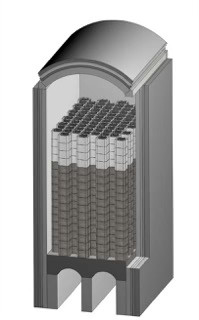
We deliver customized refractory and thermal designs for glass regenerators, to enhance heat exchange efficiency, structural stability, and campaign life.
MRL’s refractory solutions empower glass manufacturers to achieve safer, more efficient, and continuous production. With a proven track record, we have supplied high-performance refractories to float glass lines with daily pull rates ranging from 400 to 1,000 tons, ensuring furnace stability and optimized campaign life. By partnering with MRL, customers significantly mitigate the risk of unscheduled cold repairs, prolong furnace longevity, and enhance both glass quality and pack rates.
We deliver customized refractory and thermal designs for glass regenerators, to enhance heat exchange efficiency, structural stability, and campaign life.
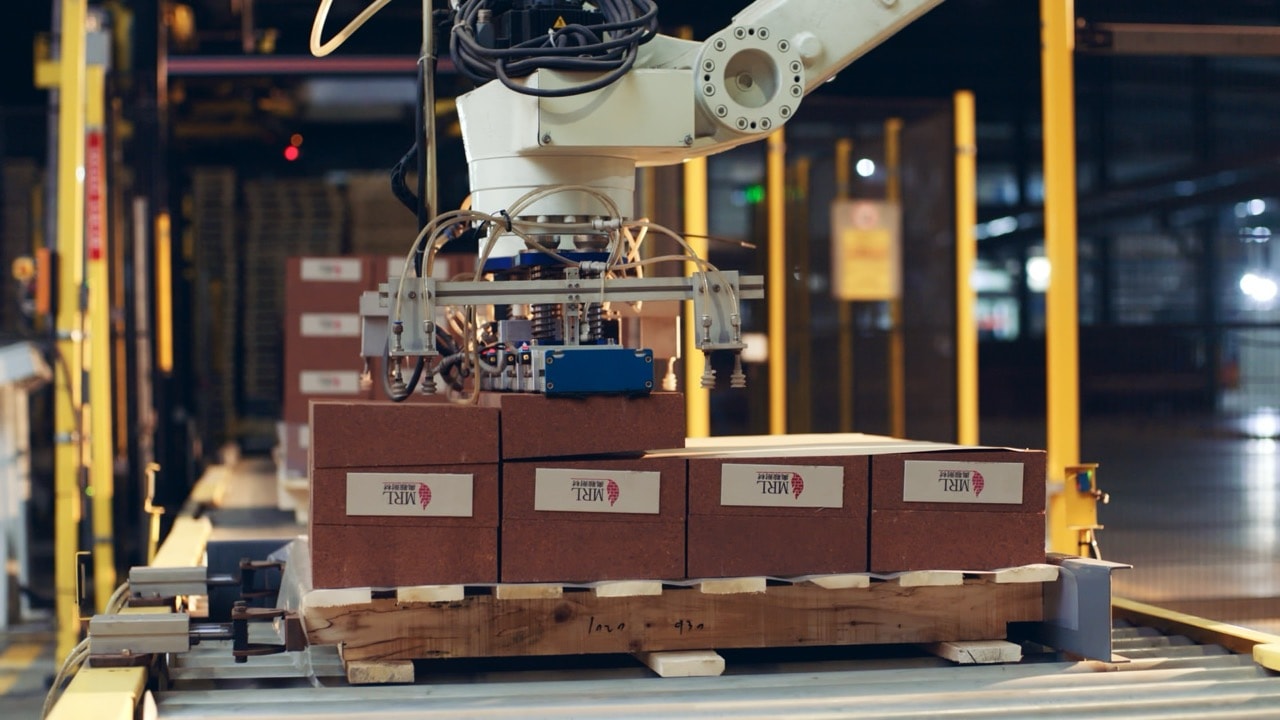
We offer a full range of in-house developed refractory products, tailored to withstand chemical attack and thermal shock under heavy oil, natural gas, and petcoke firing.
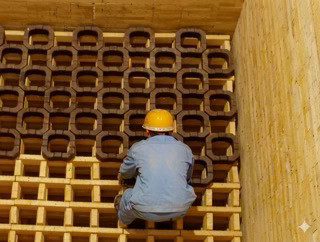
We deliver standardized installation, on-site support, and remote guidance to ensure construction quality and efficiency.
We provide full-lifecycle technical support aimed at extending lining life, enhancing operational performance, and minimizing the risk of unscheduled cold repairs.
In glass production, the structural integrity and refractory configuration of regenerators directly determine thermal efficiency, energy performance, and campaign longevity. MRL provides zone-specific material solutions for the crown, target walls, checkerwork, and rider arches, addressing corrosion challenges caused by SOx, alkali volatiles, and vanadium from various fuel types. Supported by a comprehensive product portfolio and on-site technical expertise, MRL helps customers build stable, durable, and energy-efficient regenerator systems.
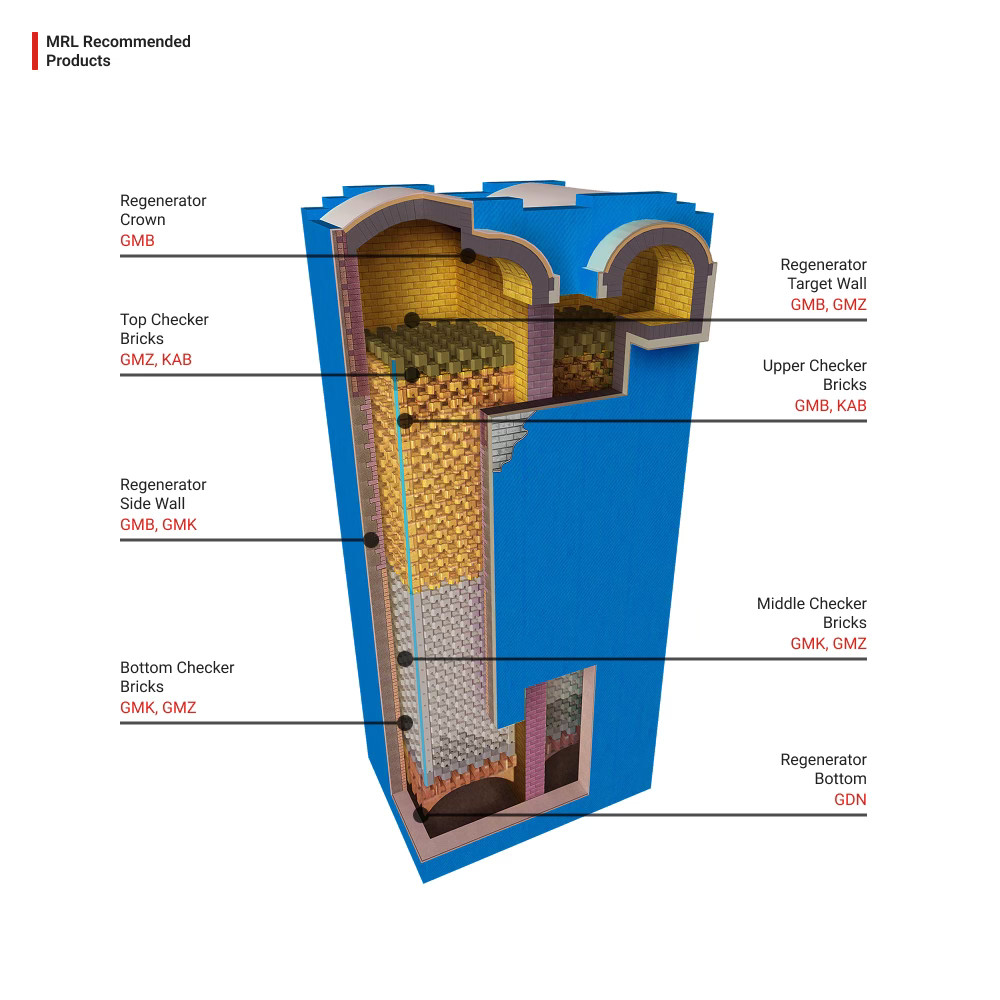
The regenerator crown forms the arched enclosure at the top of the regenerator, supporting its own weight and protecting the checkerwork below. As the area closest to the combustion chamber and high-temperature exhaust gases, the crown must withstand intense thermal shock and chemical attack while maintaining structural integrity and effective thermal insulation.
Challenge
In the crown zone, refractory linings face synergistic stresses. Vanadium- and sulfur-bearing volatiles from fuels such as heavy oil rise with flue gases and may condense on the crown surface, causing severe chemical corrosion that degrades material strength and increases the risk of penetration or even structural collapse. Simultaneously, frequent regenerator reversals generate cyclic temperature fluctuations, subjecting crown bricks to repeated thermal shock and thermal stress accumulation, which can lead to cracking and spalling. Additionally, the crown must bear the constant dead load of the arch and insulation; under prolonged high-temperature exposure, improper material selection can result in arch deformation or sagging, compromising furnace safety.
Solution
To address these challenges, MRL recommends GMB series high-performance magnesia bricks as the primary solution. GMB bricks offer excellent thermal shock resistance and strong resistance to vanadium/sulfur-induced corrosion, maintaining stability under frequent reversals and high-temperature exposure to significantly extend crown service life. For extreme conditions involving pet-coke or heavy oil with high impurity concentrations, KAB series fused chrome-corundum bricks are applied as an enhanced option. With exceptional chemical resistance, a densified microstructure, and superior creep resistance, KAB bricks provide reliable protection and a maximized safety margin in the most demanding crown environments.
Based on service conditions, MRL selects different grades and formulations even within the same series to ensure optimal performance by zone. Custom solutions are available—contact us for tailored support.Contact us for more information for your specific application
The regenerator supporting structure serves as the primary load-bearing framework for the crown and checkerwork, encompassing the target walls, partition walls, and sidewalls. This zone must maintain long-term structural stability while enduring combined synergistic stresses—including thermal cycling, heavy mechanical loads, and chemical attack from batch carryover and alkali vapors. These conditions place stringent demands on refractory strength, thermal shock resistance, and persistent structural integrity.
Challenge & Solution
Target Wall
The target wall faces direct flame impingement and chemical attack from batch carryover and fuel impurities, making it prone to surface erosion and structural thinning. MRL applies GMB high-purity magnesia bricks or GMZ corrosion-resistant bricks to resist alkaline vapors and fly-ash erosion, ensuring the long-term durability of the regenerator enclosure.
Spring Line
As the critical transition between the crown and walls, the spring line bears the lateral thrust and vertical load of the arch. It is highly susceptible to stress concentration and cracking due to repeated thermal expansion and contraction. MRL utilizes GMB or GMK high-strength bricks to balance load-bearing capacity with superior thermal shock resistance, securing the structural integrity of the entire arch system.
Partition Wall
Partition walls endure cyclic thermal stress and vertical loads; accumulated thermal shock can lead to cracking, potentially compromising chamber isolation. MRL applies GMB or GMK bricks in the high-temperature upper sections, transitioning to GDN low-porosity fireclay bricks in the lower sections to optimize thermal stability and long-term load-bearing performance.
Sidewalls
Sidewalls are continuously exposed to dust-laden gases and alkali vapors, where gas abrasion and chemical penetration can cause lining deformation. MRL optimizes sidewall configurations using GMB, GMK, or GDN series bricks based on specific thermal and flow gradients, ensuring excellent erosion resistance and prolonged service life.
Based on service conditions, MRL selects different grades and formulations even within the same series to ensure optimal performance by zone. Custom solutions are available—contact us for tailored support.
The regenerator checkerwork is the most structurally intricate and functionally vital part of the system. Thousands of checker bricks are precision-stacked to form vertical flues, which alternately capture heat from high-temperature exhaust and transfer it to combustion air during flow reversal. This process plays a decisive role in thermal efficiency, fuel economy, and overall operational stability.
Challenge & Solution
Upper Checker Zone
The upper zone operates under extreme temperatures and is subjected to intense thermal cycling, alkali vapor infiltration, and abrasive batch carryover. These conditions trigger alkali attack, surface melting, and thermal spalling, which can lead to premature structural failure. MRL provides GMB high-purity magnesia bricks as the standard high-performance solution. For harsher fuel environments, KAB or KAB-SR chrome-corundum bricks are deployed to offer superior resistance to both thermal shock and chemical erosion, ensuring long-term stability of the upper stack.
Middle Checker Zone
The middle checker zone functions within the critical temperature range where sulfate condensation and crystallization repeatedly occur. The cyclic deposition of salts within the brick pores leads to progressive internal pressure and structural degradation. MRL utilizes the GMZ and GMK series, engineered for balanced sulfate resistance and thermal stability. Additionally, GMS olivine bricks can be selectively applied to inhibit chemical corrosion and maintain the overall integrity of the checkerwork.
Lower Checker Zone
While temperatures are lower, this zone must withstand acid condensation and bear the entire mechanical load of the checker stack. Exceptional compressive strength and creep resistance are mandatory to prevent structural deformation under sustained high-pressure loading. MRL installs GDN low-porosity fireclay bricks at the base layers. These bricks ensure a stable load-bearing foundation and prevent adverse chemical reactions, significantly mitigating the risk of checkerwork collapse.
Based on service conditions, MRL selects different grades and formulations even within the same series to ensure optimal performance by zone. Custom solutions are available—contact us for tailored support.
The regenerator bottom zone, situated beneath the checkerwork, serves as the foundational layer for the entire structure. The bottom refractories are installed upon the support arches or the furnace floor, sustaining the immense dead load of the checker stack while acting as the final channel for flue gas before discharge. Although shielded from direct flame radiation, this zone is vital for structural integrity and gas collection throughout the flow-reversal cycles.
Challenge
The bottom zone is subjected to acidic condensation, dust accumulation, and sustained mechanical stress. Dust and debris falling from the checker flues tend to aggregate at the base, potentially restricting airflow and accelerating chemical attack. Most critically, the bottom refractories must support a massive static load—frequently reaching 8–10 t/m². This necessitates exceptional high-temperature creep resistance to prevent gradual settlement, structural compression, or stress-induced cracking.
Solution
MRL recommends GDN low-porosity fireclay bricks for the bottom zone. Characterized by high bulk density, minimal apparent porosity, and superior high-temperature strength, GDN bricks offer superior resistance to acidic condensates while maintaining dimensional stability under extreme pressure. Their outstanding creep resistance ensures that the foundation remains secure, preventing deformation or structural collapse during prolonged high-temperature service.
Based on service conditions, MRL selects different grades and formulations even within the same series to ensure optimal performance by zone. Custom solutions are available—contact us for tailored support.
MRL’s refractory solutions empower glass manufacturers to achieve safer, more efficient, and continuous production. With a proven track record, we have supplied high-performance refractories to float glass lines with daily pull rates ranging from 400 to 1,000 tons, ensuring furnace stability and optimized campaign life. By partnering with MRL, customers significantly mitigate the risk of unscheduled cold repairs, prolong furnace longevity, and enhance both glass quality and pack rates.
We deliver customized refractory and thermal designs for glass regenerators, to enhance heat exchange efficiency, structural stability, and campaign life.
We offer a full range of in-house developed refractory products, tailored to withstand chemical attack and thermal shock under heavy oil, natural gas, and petcoke firing.
We deliver standardized installation, on-site support, and remote guidance to ensure construction quality and efficiency.
We provide full-lifecycle technical support aimed at extending lining life, enhancing operational performance, and minimizing the risk of unscheduled cold repairs.
In glass production, the structural integrity and refractory configuration of regenerators directly determine thermal efficiency, energy performance, and campaign longevity. MRL provides zone-specific material solutions for the crown, target walls, checkerwork, and rider arches, addressing corrosion challenges caused by SOx, alkali volatiles, and vanadium from various fuel types. Supported by a comprehensive product portfolio and on-site technical expertise, MRL helps customers build stable, durable, and energy-efficient regenerator systems.
The regenerator crown forms the arched enclosure at the top of the regenerator, supporting its own weight and protecting the checkerwork below. As the area closest to the combustion chamber and high-temperature exhaust gases, the crown must withstand intense thermal shock and chemical attack while maintaining structural integrity and effective thermal insulation.
Challenge
In the crown zone, refractory linings face synergistic stresses. Vanadium- and sulfur-bearing volatiles from fuels such as heavy oil rise with flue gases and may condense on the crown surface, causing severe chemical corrosion that degrades material strength and increases the risk of penetration or even structural collapse. Simultaneously, frequent regenerator reversals generate cyclic temperature fluctuations, subjecting crown bricks to repeated thermal shock and thermal stress accumulation, which can lead to cracking and spalling. Additionally, the crown must bear the constant dead load of the arch and insulation; under prolonged high-temperature exposure, improper material selection can result in arch deformation or sagging, compromising furnace safety.
Solution
To address these challenges, MRL recommends GMB series high-performance magnesia bricks as the primary solution. GMB bricks offer excellent thermal shock resistance and strong resistance to vanadium/sulfur-induced corrosion, maintaining stability under frequent reversals and high-temperature exposure to significantly extend crown service life. For extreme conditions involving pet-coke or heavy oil with high impurity concentrations, KAB series fused chrome-corundum bricks are applied as an enhanced option. With exceptional chemical resistance, a densified microstructure, and superior creep resistance, KAB bricks provide reliable protection and a maximized safety margin in the most demanding crown environments.
Based on service conditions, MRL selects different grades and formulations even within the same series to ensure optimal performance by zone. Custom solutions are available—contact us for tailored support.Contact us for more information for your specific application
The regenerator supporting structure serves as the primary load-bearing framework for the crown and checkerwork, encompassing the target walls, partition walls, and sidewalls. This zone must maintain long-term structural stability while enduring combined synergistic stresses—including thermal cycling, heavy mechanical loads, and chemical attack from batch carryover and alkali vapors. These conditions place stringent demands on refractory strength, thermal shock resistance, and persistent structural integrity.
Challenge & Solution
Target Wall
The target wall faces direct flame impingement and chemical attack from batch carryover and fuel impurities, making it prone to surface erosion and structural thinning. MRL applies GMB high-purity magnesia bricks or GMZ corrosion-resistant bricks to resist alkaline vapors and fly-ash erosion, ensuring the long-term durability of the regenerator enclosure.
Spring Line
As the critical transition between the crown and walls, the spring line bears the lateral thrust and vertical load of the arch. It is highly susceptible to stress concentration and cracking due to repeated thermal expansion and contraction. MRL utilizes GMB or GMK high-strength bricks to balance load-bearing capacity with superior thermal shock resistance, securing the structural integrity of the entire arch system.
Partition Wall
Partition walls endure cyclic thermal stress and vertical loads; accumulated thermal shock can lead to cracking, potentially compromising chamber isolation. MRL applies GMB or GMK bricks in the high-temperature upper sections, transitioning to GDN low-porosity fireclay bricks in the lower sections to optimize thermal stability and long-term load-bearing performance.
Sidewalls
Sidewalls are continuously exposed to dust-laden gases and alkali vapors, where gas abrasion and chemical penetration can cause lining deformation. MRL optimizes sidewall configurations using GMB, GMK, or GDN series bricks based on specific thermal and flow gradients, ensuring excellent erosion resistance and prolonged service life.
Based on service conditions, MRL selects different grades and formulations even within the same series to ensure optimal performance by zone. Custom solutions are available—contact us for tailored support.
The regenerator checkerwork is the most structurally intricate and functionally vital part of the system. Thousands of checker bricks are precision-stacked to form vertical flues, which alternately capture heat from high-temperature exhaust and transfer it to combustion air during flow reversal. This process plays a decisive role in thermal efficiency, fuel economy, and overall operational stability.
Challenge & Solution
Upper Checker Zone
The upper zone operates under extreme temperatures and is subjected to intense thermal cycling, alkali vapor infiltration, and abrasive batch carryover. These conditions trigger alkali attack, surface melting, and thermal spalling, which can lead to premature structural failure. MRL provides GMB high-purity magnesia bricks as the standard high-performance solution. For harsher fuel environments, KAB or KAB-SR chrome-corundum bricks are deployed to offer superior resistance to both thermal shock and chemical erosion, ensuring long-term stability of the upper stack.
Middle Checker Zone
The middle checker zone functions within the critical temperature range where sulfate condensation and crystallization repeatedly occur. The cyclic deposition of salts within the brick pores leads to progressive internal pressure and structural degradation. MRL utilizes the GMZ and GMK series, engineered for balanced sulfate resistance and thermal stability. Additionally, GMS olivine bricks can be selectively applied to inhibit chemical corrosion and maintain the overall integrity of the checkerwork.
Lower Checker Zone
While temperatures are lower, this zone must withstand acid condensation and bear the entire mechanical load of the checker stack. Exceptional compressive strength and creep resistance are mandatory to prevent structural deformation under sustained high-pressure loading. MRL installs GDN low-porosity fireclay bricks at the base layers. These bricks ensure a stable load-bearing foundation and prevent adverse chemical reactions, significantly mitigating the risk of checkerwork collapse.
Based on service conditions, MRL selects different grades and formulations even within the same series to ensure optimal performance by zone. Custom solutions are available—contact us for tailored support.
The regenerator bottom zone, situated beneath the checkerwork, serves as the foundational layer for the entire structure. The bottom refractories are installed upon the support arches or the furnace floor, sustaining the immense dead load of the checker stack while acting as the final channel for flue gas before discharge. Although shielded from direct flame radiation, this zone is vital for structural integrity and gas collection throughout the flow-reversal cycles.
Challenge
The bottom zone is subjected to acidic condensation, dust accumulation, and sustained mechanical stress. Dust and debris falling from the checker flues tend to aggregate at the base, potentially restricting airflow and accelerating chemical attack. Most critically, the bottom refractories must support a massive static load—frequently reaching 8–10 t/m². This necessitates exceptional high-temperature creep resistance to prevent gradual settlement, structural compression, or stress-induced cracking.
Solution
MRL recommends GDN low-porosity fireclay bricks for the bottom zone. Characterized by high bulk density, minimal apparent porosity, and superior high-temperature strength, GDN bricks offer superior resistance to acidic condensates while maintaining dimensional stability under extreme pressure. Their outstanding creep resistance ensures that the foundation remains secure, preventing deformation or structural collapse during prolonged high-temperature service.
Based on service conditions, MRL selects different grades and formulations even within the same series to ensure optimal performance by zone. Custom solutions are available—contact us for tailored support.
MRL’s refractory solutions empower glass manufacturers to achieve safer, more efficient, and continuous production. With a proven track record, we have supplied high-performance refractories to float glass lines with daily pull rates ranging from 400 to 1,000 tons, ensuring furnace stability and optimized campaign life. By partnering with MRL, customers significantly mitigate the risk of unscheduled cold repairs, prolong furnace longevity, and enhance both glass quality and pack rates.
We deliver customized refractory and thermal designs for glass regenerators, to enhance heat exchange efficiency, structural stability, and campaign life.
We offer a comprehensive portfolio of in-house developed refractory products, tailored to withstand chemical attack and thermal shock under heavy oil, natural gas, and pet-coke firing.
We deliver standardized installation, on-site support, and remote guidance to ensure construction quality and efficiency.
We provide full-lifecycle technical support aimed at extending lining life, enhancing operational performance, and minimizing the risk of unscheduled cold repairs.
In glass production, the structural integrity and refractory configuration of regenerators directly determine thermal efficiency, energy performance, and campaign longevity. MRL provides zone-specific material solutions for the crown, target walls, checkerwork, and rider arches, addressing corrosion challenges caused by SOx, alkali volatiles, and vanadium from various fuel types. Supported by a comprehensive product portfolio and on-site technical expertise, MRL helps customers build stable, durable, and energy-efficient regenerator systems.
The regenerator crown forms the arched enclosure at the top of the regenerator, supporting its own weight and protecting the checkerwork below. As the area closest to the combustion chamber and high-temperature exhaust gases, the crown must withstand intense thermal shock and chemical attack while maintaining structural integrity and effective thermal insulation.
Challenge
In the crown zone, refractory linings face synergistic stresses. Vanadium- and sulfur-bearing volatiles from fuels such as heavy oil rise with flue gases and may condense on the crown surface, causing severe chemical corrosion that degrades material strength and increases the risk of penetration or even structural collapse. Simultaneously, frequent regenerator reversals generate cyclic temperature fluctuations, subjecting crown bricks to repeated thermal shock and thermal stress accumulation, which can lead to cracking and spalling. Additionally, the crown must bear the constant dead load of the arch and insulation; under prolonged high-temperature exposure, improper material selection can result in arch deformation or sagging, compromising furnace safety.
Solution
To address these challenges, MRL recommends GMB series high-performance magnesia bricks as the primary solution. GMB bricks offer excellent thermal shock resistance and strong resistance to vanadium/sulfur-induced corrosion, maintaining stability under frequent reversals and high-temperature exposure to significantly extend crown service life. For extreme conditions involving pet-coke or heavy oil with high impurity concentrations, KAB series fused chrome-corundum bricks are applied as an enhanced option. With exceptional chemical resistance, a densified microstructure, and superior creep resistance, KAB bricks provide reliable protection and a maximized safety margin in the most demanding crown environments.
Based on service conditions, MRL selects different grades and formulations even within the same series to ensure optimal performance by zone. Custom solutions are available—contact us for tailored support.Contact us for more information for your specific application
The regenerator supporting structure serves as the primary load-bearing framework for the crown and checkerwork, encompassing the target walls, partition walls, and sidewalls. This zone must maintain long-term structural stability while enduring combined synergistic stresses—including thermal cycling, heavy mechanical loads, and chemical attack from batch carryover and alkali vapors. These conditions place stringent demands on refractory strength, thermal shock resistance, and persistent structural integrity.
Challenge & Solution
Target Wall
The target wall faces direct flame impingement and chemical attack from batch carryover and fuel impurities, making it prone to surface erosion and structural thinning. MRL applies GMB high-purity magnesia bricks or GMZ corrosion-resistant bricks to resist alkaline vapors and fly-ash erosion, ensuring the long-term durability of the regenerator enclosure.
Spring Line
As the critical transition between the crown and walls, the spring line bears the lateral thrust and vertical load of the arch. It is highly susceptible to stress concentration and cracking due to repeated thermal expansion and contraction. MRL utilizes GMB or GMK high-strength bricks to balance load-bearing capacity with superior thermal shock resistance, securing the structural integrity of the entire arch system.
Partition Wall
Partition walls endure cyclic thermal stress and vertical loads; accumulated thermal shock can lead to cracking, potentially compromising chamber isolation. MRL applies GMB or GMK bricks in the high-temperature upper sections, transitioning to GDN low-porosity fireclay bricks in the lower sections to optimize thermal stability and long-term load-bearing performance.
Sidewalls
Sidewalls are continuously exposed to dust-laden gases and alkali vapors, where gas abrasion and chemical penetration can cause lining deformation. MRL optimizes sidewall configurations using GMB, GMK, or GDN series bricks based on specific thermal and flow gradients, ensuring excellent erosion resistance and prolonged service life.
Based on service conditions, MRL selects different grades and formulations even within the same series to ensure optimal performance by zone. Custom solutions are available—contact us for tailored support.
The regenerator checkerwork is the most structurally intricate and functionally vital part of the system. Thousands of checker bricks are precision-stacked to form vertical flues, which alternately capture heat from high-temperature exhaust and transfer it to combustion air during flow reversal. This process plays a decisive role in thermal efficiency, fuel economy, and overall operational stability.
Challenge & Solution
Upper Checker Zone
The upper zone operates under extreme temperatures and is subjected to intense thermal cycling, alkali vapor infiltration, and abrasive batch carryover. These conditions trigger alkali attack, surface melting, and thermal spalling, which can lead to premature structural failure. MRL provides GMB high-purity magnesia bricks as the standard high-performance solution. For harsher fuel environments, KAB or KAB-SR chrome-corundum bricks are deployed to offer superior resistance to both thermal shock and chemical erosion, ensuring long-term stability of the upper stack.
Middle Checker Zone
The middle checker zone functions within the critical temperature range where sulfate condensation and crystallization repeatedly occur. The cyclic deposition of salts within the brick pores leads to progressive internal pressure and structural degradation. MRL utilizes the GMZ and GMK series, engineered for balanced sulfate resistance and thermal stability. Additionally, GMS olivine bricks can be selectively applied to inhibit chemical corrosion and maintain the overall integrity of the checkerwork.
Lower Checker Zone
While temperatures are lower, this zone must withstand acid condensation and bear the entire mechanical load of the checker stack. Exceptional compressive strength and creep resistance are mandatory to prevent structural deformation under sustained high-pressure loading. MRL installs GDN low-porosity fireclay bricks at the base layers. These bricks ensure a stable load-bearing foundation and prevent adverse chemical reactions, significantly mitigating the risk of checkerwork collapse.
Based on service conditions, MRL selects different grades and formulations even within the same series to ensure optimal performance by zone. Custom solutions are available—contact us for tailored support.
The regenerator bottom zone, situated beneath the checkerwork, serves as the foundational layer for the entire structure. The bottom refractories are installed upon the support arches or the furnace floor, sustaining the immense dead load of the checker stack while acting as the final channel for flue gas before discharge. Although shielded from direct flame radiation, this zone is vital for structural integrity and gas collection throughout the flow-reversal cycles.
Challenge
The bottom zone is subjected to acidic condensation, dust accumulation, and sustained mechanical stress. Dust and debris falling from the checker flues tend to aggregate at the base, potentially restricting airflow and accelerating chemical attack. Most critically, the bottom refractories must support a massive static load—frequently reaching 8–10 t/m². This necessitates exceptional high-temperature creep resistance to prevent gradual settlement, structural compression, or stress-induced cracking.
Solution
MRL recommends GDN low-porosity fireclay bricks for the bottom zone. Characterized by high bulk density, minimal apparent porosity, and superior high-temperature strength, GDN bricks offer superior resistance to acidic condensates while maintaining dimensional stability under extreme pressure. Their outstanding creep resistance ensures that the foundation remains secure, preventing deformation or structural collapse during prolonged high-temperature service.
Based on service conditions, MRL selects different grades and formulations even within the same series to ensure optimal performance by zone. Custom solutions are available—contact us for tailored support.